



Research report | November 3, 2026
Scope: Canadian and Ontario economic conditions, U.S. economic developments, interest rates, inflation, energy markets, international conflicts, Canada–U.S. trade negotiations and the implications of the American midterm elections.
This report draws on the Bank of Canada, Statistics Canada, Ontario Ministry of Finance, Financial Accountability Office of Ontario, Parliamentary Budget Officer, U.S. Federal Reserve, U.S. Energy Information Administration and established news organizations.
The research supports a report within your requested 1,500–1,700 words, so an extension is not necessary. All forecasts are identified as forecasts rather than established facts. The report reflects information available on November 3, before the U.S. election results are known.
Executive summary
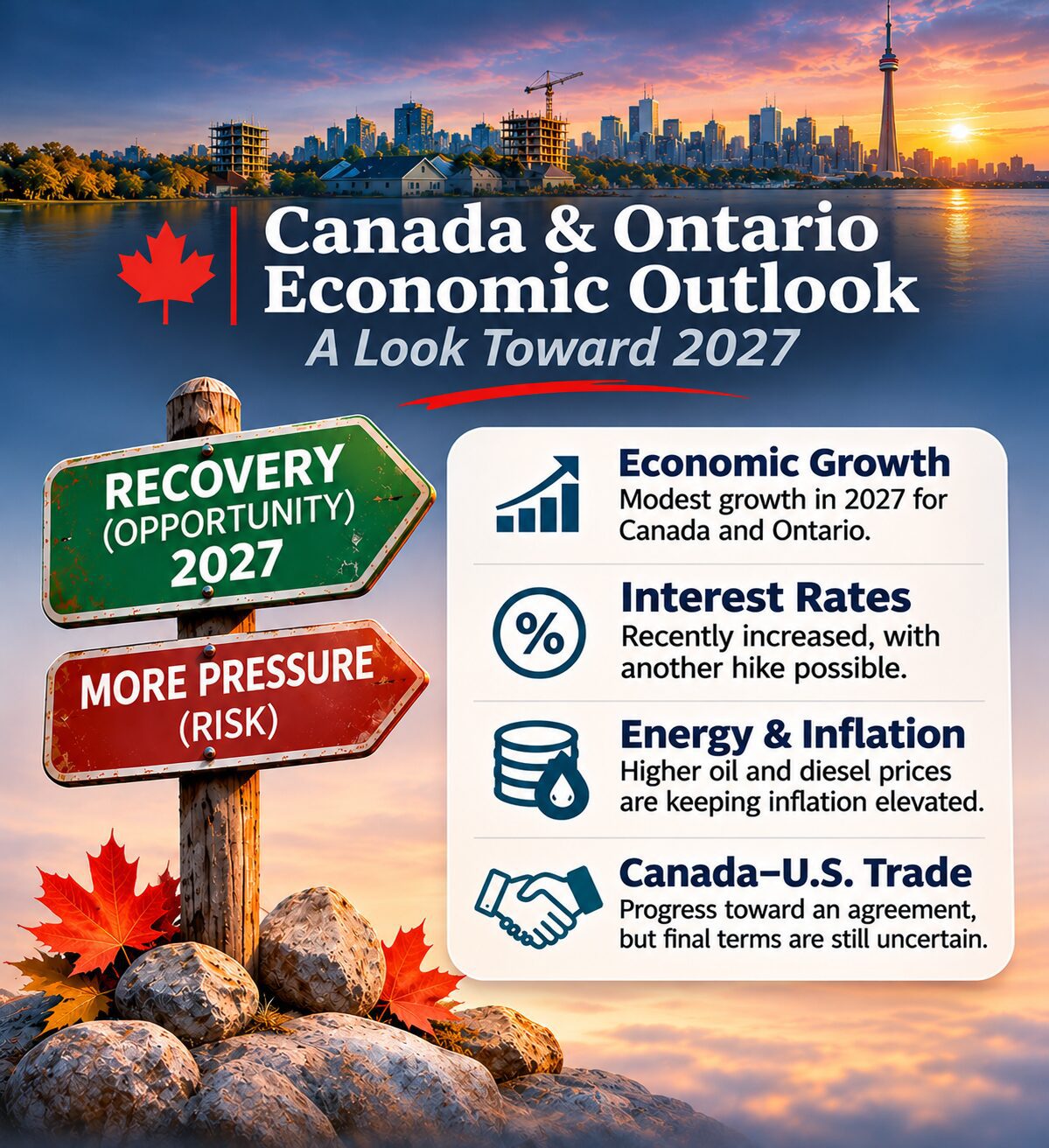
Canada enters the final months of 2026 facing an unusual economic combination: modest growth, rising inflation, higher borrowing costs and substantial uncertainty surrounding its most important trading relationship.
Ontario is particularly exposed. Its manufacturing sector, automotive industry, construction activity and housing market are sensitive to American trade policy and Canadian interest rates.
There are reasons for cautious optimism about 2027. The Bank of Canada expects national economic growth to strengthen to 2%, while Ontario forecasts growth of 1.5%. However, those projections depend on assumptions about energy prices, trade conditions, investment and consumer spending.
Three developments will be particularly important: whether energy prices stabilize, whether Canada and the United States establish more predictable trade arrangements, and whether inflation pressures require additional interest rate increases.
The central conclusion is that 2027 could bring an economic recovery, but it is unlikely to be a rapid or evenly distributed one.
1. Canada’s economy: Growth, but considerable pressure
The Canadian economy has demonstrated more resilience than might have been expected given the trade disruptions and geopolitical uncertainty of 2026.
According to the Bank of Canada, real gross domestic product grew at an annualized rate of 3.3% in the second quarter, with preliminary indicators suggesting approximately 2% growth in the third quarter.
Nevertheless, the Bank expects economic growth of just 1% for 2026 before improving to 2% in both 2027 and 2028.
The Parliamentary Budget Officer offers a more cautious assessment, forecasting growth of 0.9% in 2026 and 1.5% in 2027. Its projections incorporate the negative effects of existing American tariffs and Canadian countermeasures.
These forecasts are not contradictory in principle. They reflect different modelling assumptions, including expectations concerning inflation, trade and interest rates.
The employment picture also remains mixed. Statistics Canada reported that employment declined by 68,000 positions in September, while the national unemployment rate reached 6.5%.
The challenge for policymakers is that economic growth remains relatively weak even as inflation has accelerated. That combination limits the Bank of Canada’s ability to stimulate the economy through lower interest rates.
2. Ontario: A slower economy with particular vulnerabilities
Ontario’s economic outlook is weaker than Canada’s national outlook.
The Ontario government’s October 2026 Fall Economic Statement projects real GDP growth of only 0.5% this year, improving to 1.5% in 2027 and 1.8% in 2028.
The independent Financial Accountability Office projects similar growth of 0.6% in 2026 and 1.5% in 2027.
Real GDP growth forecasts
- 2026: Canada 1%, Ontario 0.5%
- 2027: Canada 2%, Ontario 1.5%
- 2028: Canada 2%, Ontario 1.8%
Ontario’s exposure to U.S. tariffs is especially significant because of its integrated manufacturing industries. Automotive parts, vehicles, steel and other manufactured products frequently move across the Canada–U.S. border.
When tariffs increase costs or make future market access uncertain, businesses may postpone investment, hiring or expansion.
Ontario’s labour market reflects some of these pressures. Employment declined by approximately 20,000 in September, although it remained 86,000 higher than a year earlier. Provincial unemployment stood at 7%.
Provincial finances also deserve attention. The Financial Accountability Office projects a $16.9 billion Ontario budget deficit for 2026–27, illustrating the difficulty of maintaining public services and investment during slower economic growth.
Ontario’s recovery will depend heavily on business confidence, stronger trade conditions and improved household purchasing power.
3. Interest rates: Why the Bank of Canada changed direction
On October 28, the Bank of Canada increased its overnight policy rate by 0.25 percentage points, bringing it to 2.5%. This was the first rate increase since July 2023.
The Bank’s decision was primarily motivated by concern that elevated energy prices could produce broader, persistent inflation.
Consumer price inflation has remained around 3% since April, and the Bank forecasts that it could reach approximately 3.5% by the end of 2026. Importantly, inflation excluding gasoline was only 2.2% in September, while core inflation measures remained close to 2%.
The distinction matters. Much of the current inflation pressure originates from energy, rather than an overheated domestic economy. However, when transportation and production costs increase, businesses eventually pass some of those expenses to customers. The Bank is attempting to prevent those increases from becoming embedded throughout the economy.
Governor Tiff Macklem confirmed that additional rate increases may be necessary, but emphasized that future decisions will be made cautiously. The next scheduled announcement is December 9. Another increase is possible, but it is not a certainty. The decision will depend on incoming inflation, employment and economic activity data.
4. Energy prices and the wars in the Middle East and Ukraine
International conflicts have become important drivers of North American inflation.
The ongoing Middle East conflict, including the war involving Iran, has disrupted oil production and transportation. Risks to shipping through the Strait of Hormuz have added uncertainty to global energy markets.
Russia’s continuing war against Ukraine contributes additional geopolitical and energy-market uncertainty, although the two conflicts affect oil markets through different mechanisms.
The U.S. Energy Information Administration’s October forecast estimated Brent crude oil would average US$105 per barrel during the fourth quarter of 2026. It projected an average of US$84 in 2027, assuming production and transportation conditions gradually improve.
Diesel deserves particular attention. The EIA reported that U.S. diesel prices averaged US$6.29 per gallon in September, reflecting both higher crude prices and constrained refining supplies. Diesel powers much of the transportation, agriculture, construction and distribution systems that support the North American economy.
Higher diesel costs therefore affect considerably more than motorists. They increase the expense of moving food, building materials, manufactured goods and other products.
Canada is both an energy producer and an energy consumer. Higher oil prices can benefit producers and certain provincial economies while increasing costs for households and businesses elsewhere. The key uncertainty for 2027 is whether energy supplies normalize sufficiently to relieve inflationary pressure. The EIA’s forecast assumes improvement; it cannot guarantee it.
5. Canada–U.S. trade: The most important economic uncertainty
The Canada–U.S. trading relationship remains fundamental to Canada’s prosperity.
According to recently reported trade figures, 71.7% of Canadian merchandise exports went to the United States in 2025. Tariffs and uncertainty about future market access, therefore, have consequences extending well beyond directly affected exporters.
The Parliamentary Budget Officer estimates that bilateral trade measures introduced since early 2025, if maintained permanently, could reduce Canada’s real GDP level by approximately 1.4% over the medium term compared with a scenario without those measures. That represents a meaningful potential loss of economic output. Recent negotiations offer some encouragement.
On November 1, Prime Minister Mark Carney and President Donald Trump both described progress toward a possible trade agreement. However, no final terms have been announced. Discussions involve tariffs affecting automobiles, steel and other products, alongside broader questions about the future of continental trade arrangements.
The Canada–United States–Mexico Agreement remains in force, but its review and unresolved disagreements continue to create uncertainty. An agreement could restore confidence and encourage investment. Nevertheless, the economic value of any agreement will depend on its actual provisions, including tariff relief, exemptions, rules of origin and the predictability of future trade rules. It would be premature to assume that an agreement is imminent or that it will restore previous trading conditions.
For Ontario manufacturers, certainty about future market access may be almost as important as the immediate reduction of tariffs.
6. The United States: Economic strength and political uncertainty
The American economy remains comparatively resilient. At its October 28 meeting, the U.S. Federal Reserve maintained its benchmark interest-rate range at 3.75%–4%. The Federal Reserve reported continued economic expansion, resilient consumer spending, strong productivity and substantial capital investment. However, American inflation remains elevated, and the Federal Reserve continues to monitor the effects of geopolitical uncertainty.
This matters to Canada because American consumer demand supports Canadian exports, while U.S. monetary policy influences financial conditions and currency markets across North America.
Yesterday, November 3, Americans voted in their midterm elections. The election was a Democratic tsunami. The new composition of the House of Representatives and Senate could influence future legislative negotiations involving taxation, government spending, energy and trade.
However, congressional elections do not automatically determine tariff policy. The executive branch retains significant trade-policy authority, subject to applicable laws and judicial review. It would be inappropriate to predict how the results will change Canada–U.S. negotiations.
The immediate economic question is whether the post-election political environment supports greater policy stability or prolongs uncertainty.
Check out our latest Market Update Report here.
7. Housing, construction and consumer confidence
The combined effects of interest rates, inflation and economic uncertainty are particularly important to Ontario’s housing market. Higher borrowing costs affect mortgage affordability and can discourage potential buyers from entering the market. At the same time, homeowners renewing mortgages may face additional financial pressure, depending on their existing rates and renewal terms.
The Bank of Canada expects housing activity to remain relatively weak even as broader economic growth improves in 2027.
Construction is also affected by higher financing costs, energy expenses, material prices and uncertainty about future demand. For the Greater Toronto Area and Durham Region, the implications are significant. However, regional housing markets are not uniform. Property type, price range, local inventory, employment conditions and neighbourhood demand can produce very different outcomes.
A recovery in consumer confidence could encourage buyers who have delayed purchasing decisions to return to the market. That recovery would likely depend on greater stability in borrowing costs, employment and household finances. Importantly, a stronger economy does not automatically translate into rapidly rising home prices. Housing supply and affordability will remain important influences.
8. Three possible economic scenarios for 2027
The following scenarios are analytical illustrations, not statistical forecasts or assigned probabilities.
Scenario A: Improving conditions
Energy prices moderate, Canada and the United States establish more predictable trade arrangements, and inflation gradually eases. Business investment and consumer confidence improve, supporting a stronger recovery.
Scenario B: Gradual, uneven recovery
Trade uncertainty persists, energy costs remain elevated, and interest rates stay higher than households and businesses had anticipated. Economic growth improves modestly, but Ontario continues to underperform the national economy.
Scenario C: Renewed economic pressure
Further geopolitical disruptions raise energy prices, trade negotiations deteriorate, or inflation requires additional monetary tightening. Consumer spending, employment and investment weaken, delaying recovery.
9. Conclusions: What should we expect in 2027?
The evidence suggests that Canada’s economy has the capacity to improve in 2027, but substantial obstacles remain. The Bank of Canada’s 2% national growth forecast offers grounds for cautious optimism. Ontario’s projected 1.5% growth suggests a slower provincial recovery.
The most important development may be a reduction in uncertainty rather than any single interest-rate decision. Businesses need confidence to invest. Consumers need confidence to spend. Housing markets benefit from predictable financing conditions, while exporters require reliable access to international markets.
A constructive Canada–U.S. trade agreement, improving energy supplies and easing inflation would strengthen the outlook considerably. Conversely, prolonged conflict, additional tariffs or persistently high inflation could delay recovery. The most defensible conclusion is that 2027 offers an opportunity for improvement, not a guarantee of it.
For Ontario, particularly its manufacturing-dependent communities, the coming months will be important in determining how quickly that opportunity translates into meaningful economic growth. We’re hopeful that changes in the House & Senate translates into a renewed attitude towards trade with Canada.

Stay connected to the market.
Sign up to our digital newsletter community.